Bounding boxes
This page describes the different types of bounding boxes that tenderness provides for text and blocks.
Text bounding boxes (OBB)
All text bounding boxes are oriented bounding boxes (OBB). They capture exact text shape and orientation — even when rotated or skewed.
Char
The fundamental unit of text — a single Unicode code point. Provides a logical bounding box only.
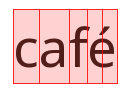
Cluster
An indivisible visual unit — one or more characters that render as a single glyph or shape, such as a ligature (fi), a diacritic (é), or a combined emoji (👨👩👦). Provides logical and ink bounding boxes.
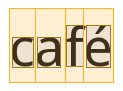
Run
A contiguous sequence of clusters sharing the same font, style, script, and text direction. Provides logical and ink bounding boxes.
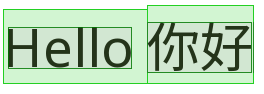
Line
A single physical row of text, determined after word-wrapping is applied. Provides logical and ink bounding boxes.
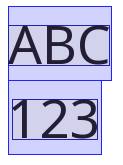
Layout
The full extent of a text block — the union of all its lines. Provides logical and ink bounding boxes.
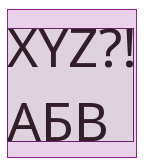
Block bounding boxes (AABB)
Block bounding boxes are axis-aligned bounding boxes (AABB). They define the position and size of each block within the document layout.